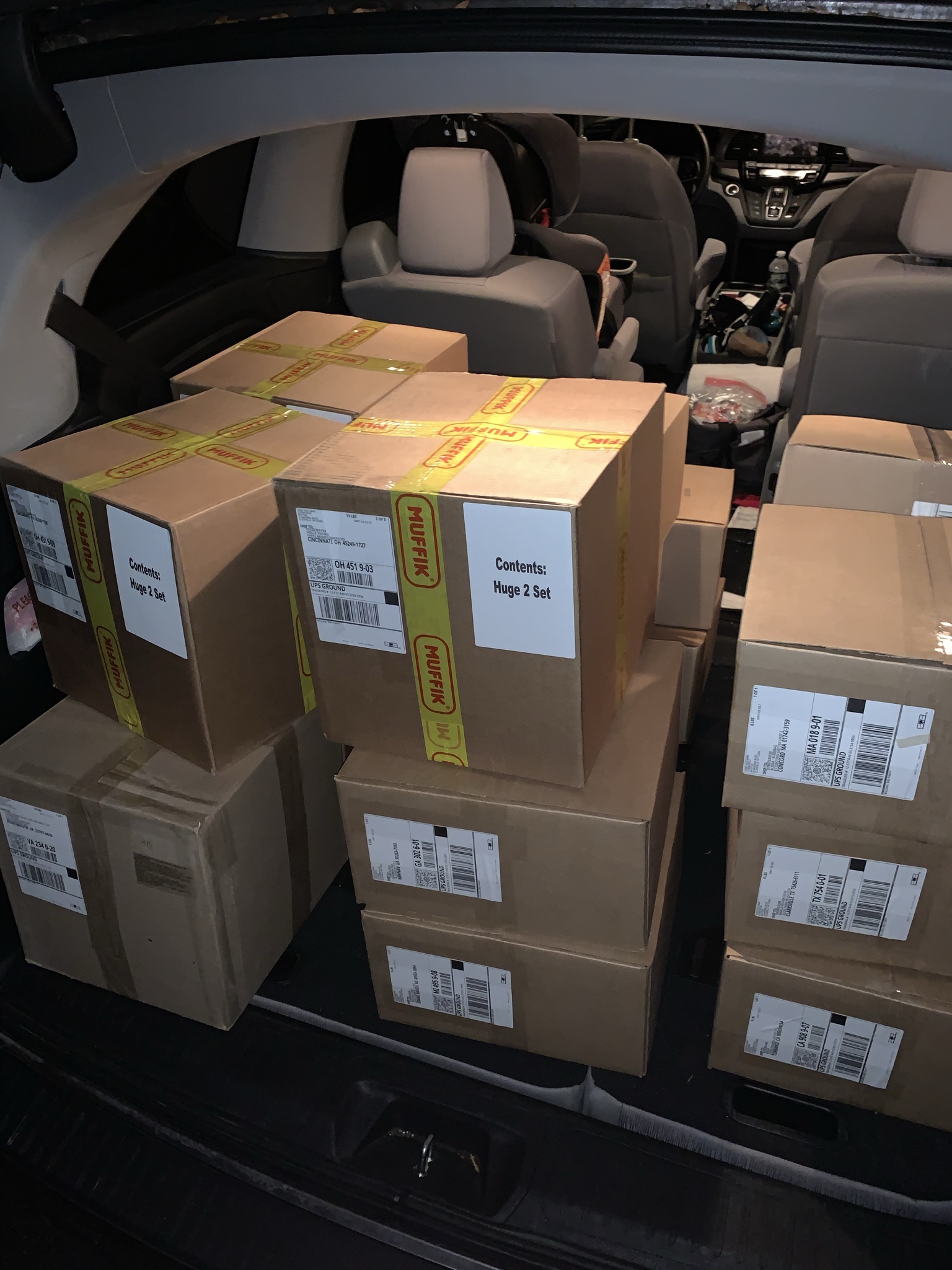
When a group of sellers stopped waiting for the supply chain to fix itself There are projects that make sense on a résumé and projects that sound almost unbelievable when reduced to a bullet point. Operation Big Push is the second kind. The participants were not a federal logistics command. We were not a giant freight carrier. We were not sitting inside one corporation with authority over the entire chain.
A lot of us were toy sellers. Amazon sellers. Business owners. People who understood products because our livelihoods depended on getting actual physical things manufactured, across borders, through ports, into warehouses and eventually into customers' hands. Then the national freight and customs system became a problem that could not be treated as somebody else's department. So we inserted ourselves into it.
That sentence can sound grander than I intend it to. I am not claiming a small group of sellers single-handedly repaired a national supply-chain crisis. There were warehouses, customs professionals, freight operators, drivers, government officials, politicians, journalists, business owners and many other people working pieces of the problem. What I remember is much more practical. Things were stuck. Businesses needed inventory.
Holiday merchandise mattered. Freight had to move. Every barrier had an owner somewhere. And if we could identify the barrier, identify the owner, understand the variance and connect the right people, sometimes we could make the next thing happen.
That was the work. It was also one of the clearest examples of a principle that followed me through the rest of my career: A large system becomes manageable when you stop treating “the system” as one giant problem and start identifying the specific condition preventing the next required state.
THE PRODUCT DOES NOT CARE ABOUT YOUR ORG CHART
Before I worked inside fulfillment buildings, I worked with sellers. That meant I learned supply chains from the perspective of a product trying to become available for sale. An idea had to become a specification. A specification had to become something a manufacturer could produce.
Production required materials, schedules, quality decisions and money. Then the product had to leave the factory. Factory to port. Port to vessel.
Across the ocean. Customs. Freight. Warehouse.
Inventory placement. Marketplace. Customer. A product can fail at any one of those transitions.
The product does not care that manufacturing and freight are different industries. It does not care that customs is a different organization. It does not care that the warehouse does not control the port. It does not care that the seller cannot personally drive the truck.
The customer sees one thing: Available, or not available. That forces a systems view. If you only understand the portion you personally own, you can be perfectly competent and still be helpless when the failure is one interface away.
Operation Big Push happened in that kind of environment. The interfaces were the problem.
WHEN EVERYBODY OWNS A PIECE, NOBODY OWNS THE JOURNEY
A complicated supply chain has an enormous number of legitimate owners. The factory owns production. The freight forwarder owns another piece. The carrier owns another.
The port has constraints. Customs has authority. The trucking company has drivers and equipment. The warehouse has receiving capacity.
The seller has inventory commitments. The marketplace has customer promises. Government has its own interests. Every one of those participants can truthfully say:
This is the part I control. And still the freight does not move. That is why cross-functional problems can survive for so long. The failure may not belong completely to anybody.
It exists between owners. My instinct in those situations has always been to build the journey. What has to happen first? What has to happen next?
What is preventing it? Who owns that condition? What variance is needed? What resource is missing?
What happens immediately after the barrier is removed? That is very different from asking, “Who is responsible for this whole mess?” The second question produces arguments. The first produces a work plan.
BARRIERS, OWNERS AND VARIANCES
If I had to compress Operation Big Push into three operational words, I would probably use: Barrier. Owner. Variance.
A barrier is the thing that prevents the next required movement. An owner is the person, organization or role capable of changing that condition. A variance is the controlled exception required when the normal process cannot solve an abnormal situation. Those concepts sound formal when written down.
In practice they can be extremely ordinary. Freight needs somewhere to stage. That is a barrier. Who controls a location that can be used?
That is an owner. Can the normal location or normal process be temporarily changed? That may require a variance. Drivers are unavailable.
Barrier. Who has drivers? Owner. Can schedules, routes, handoffs or other constraints be changed?
Variance. A business needs a product that cannot be sourced through the normal path. Barrier. Who can source it?
Owner. What alternative product, manufacturer or movement can satisfy the real requirement? Variance. Then repeat.
A giant problem starts becoming a sequence of smaller solvable problems.
THE STAGING YARD IS NOT JUST A PARKING LOT
One of the things we worked through was staging. That is another word that sounds simple until the system is overloaded. When freight cannot move directly from one step to the next, it needs somewhere to exist without becoming lost, inaccessible or disruptive. That somewhere is not incidental.
It becomes part of the architecture. A staging yard creates temporary capacity between processes that are no longer synchronized. The upstream system can release something before the downstream system is fully ready. But the buffer only helps if it is controlled.
What is in the yard? Who owns it? Where is it supposed to go? What is blocking the next move?
Which load is more urgent? Which driver can move it? Which destination can receive it? How long has it been sitting?
What happens if it remains? This is the same logic I later used inside fulfillment buildings. A stacking area is a buffer. A yard is a buffer.
A queue in software is a buffer. The physical scale changes. The systems question does not. Buffers buy time.
They do not solve the underlying constraint. If you do not manage them, eventually the buffer becomes the new constraint.
THE DRIVER IS PART OF THE SYSTEM
It is easy to discuss logistics as though trucks move themselves. They do not. A transportation plan without a driver is a diagram. A warehouse receiving plan without a truck is a schedule.
A customs release without onward movement is freight that has merely changed status. Operation Big Push made the human dependencies impossible to ignore. We needed contacts. We needed people who knew people.
We needed business owners. We needed drivers. We needed people inside systems who understood which rule was actually binding and which process had a legitimate exception path. That is why relationships matter so much in operational work.
Not because networking is magical. Because complex systems contain distributed knowledge. The person closest to the constraint often knows something the central planner does not. A driver knows what movement is actually possible.
A warehouse operator knows whether there is really room. A seller knows which inventory matters most. A customs professional knows what documentation is preventing release. A business owner knows which compromise is commercially survivable.
The operating system is partly encoded in people. Good coordination gets that knowledge into the decision before the decision becomes expensive.
ERIN AT THE TABLE
Erin was an extraordinary assistant and nanny, but those titles are too small for what she became to our family. She was part of the household, part of the work and, during Operation Big Push, part of a conversation that reached far beyond the rooms where we usually operated. She spoke with business owners, politicians and customs executives. People listened to her because she understood the work, asked the right questions and belonged in the room. Nobody had to think twice about her position once she began contributing. Her fit was obvious.
Afterward, Erin thanked me for bringing her into a world where people treated her as a peer rather than as a college kid. She had been allowed to sit at the same table and help make consequential plans. The emotion in her voice has stayed with me for years. I never imagined that what felt, from inside my own stress, like frantic and sometimes ridiculous work could mean so much to another person. Big Push gave her access to a professional world that had not been waiting for her on paper, and she proved in real time that she belonged there.
That realization also forced me to confront how narrowly I had been seeing the period. The year before, I had a $90,000 November and a $90,000 December. During Big Push, I was down $65,000. There was tension everywhere: with my wife, around the money, and among business partners. We had missed Toy Fair two years in a row because of COVID after three strong years, two of them involving new top-100 Toy of the Year products. I was so stuck in my own sulking that I did not stop to imagine what the experience meant to Erin. I could have made it more memorable for her instead of asking her to work around grumpy old me.
None of us set out to do anything great. We were trying to keep our heads up, keep promises and make the holidays as magical as circumstances allowed. The wider economic effect was an added consequence of that work, not the motive. People were exhausted after a year of quarantine and shortages. Businesses had money, inventory and commitments trapped in an unstable system. Every shipment we helped move represented somebody trying to keep a promise to a customer, a partner or a family. Erin understood the human scale of that before I did. She saw the table, the people at it and the possibility of contributing. I was still staring at the losses.
THE WATER-TEST STRIPS
One of the details I remember from that period is sourcing water-test strips for sellers. It is almost comically small compared with phrases like national freight crisis. That is precisely why I like the detail. Large-scale operations are ultimately made out of specific things.
A particular product. A particular load. A particular document. A particular driver.
A particular yard. A particular customer promise. It is easy to talk about “the supply chain” as an abstraction. Nobody orders a supply chain.
They order a thing. Somebody needed water-test strips. So the useful question was not: How do we solve global logistics?
It was: How do we get these? Solve enough concrete problems and the larger system begins moving. That is engineering from the bottom up.
POLITICIANS, JOURNALISTS AND PEOPLE WHO SELL TOYS
The group around the problem became unusually broad. Sellers. Warehouses. Customs.
Freight. Politicians. Journalists. Business owners.
People who would not normally appear on the same project chart were suddenly connected by the same physical reality. Products were not where they needed to be. That kind of problem destroys artificial boundaries very quickly. The freight does not become less stuck because two organizations normally communicate through a formal channel.
The holiday does not move because a committee needs another week. Businesses do not stop needing inventory because the organizational ownership is complicated. This does not mean bypassing controls. It means understanding what the controls are for and finding the people authorized to make legitimate decisions inside them.
That distinction has stayed important to me. There is a huge difference between ignoring a process and understanding a process well enough to find its valid exception path. At scale, rigid adherence to the normal path during an abnormal condition can be just as destructive as having no process at all. A mature system needs both.
Standard work for normal conditions. Controlled variance for abnormal ones. That is resilience.
HOLIDAY INVENTORY HAS A CLOCK
Toy sellers understand deadlines in a very unforgiving way. A toy arriving in January is not the same commercial event as a toy arriving before Christmas. The product may be identical. The economic value is not.
That changes how you think about time. Inventory is not merely late or on time. It has a window in which it matters. The same principle later appeared everywhere in my Amazon operations work.
A Critical Pull Time is a promise with a clock. A truck that misses the correct movement creates a different problem downstream. A Prime delivery promise creates a clock. A launch creates a clock.
A customer waiting for a service creates a clock. Operation Big Push reinforced that a deadline is not just a date. It changes priority. It changes value.
It changes which workaround is reasonable. It changes the cost of waiting. If you are optimizing a system without understanding the time value of the thing moving through it, you are missing part of the system.
THE NETWORK WAS BIGGER THAN ANY PARTICIPANT
Nobody involved controlled everything. That may be the most important part of the story. You do not need total authority to improve a system. You need enough understanding to identify the next constraint and enough relationships to connect the people who can change it.
That is a different model of leadership. It is not command. It is orchestration. I could not order customs to do something.
I could not manufacture a driver. I could not personally create port capacity. I could not control every warehouse. But I could help build a map.
What is stuck? Why? Who knows? Who owns the decision?
What resource exists somewhere else? What can move now? What has to wait? What needs an exception?
What is the next handoff? That kind of work can look almost invisible from the outside because the output is movement. The problem disappears into the next step. The freight moves.
The product arrives. The business continues. Then everybody goes back to thinking of the supply chain as something that simply exists. Until it stops again.
WHY THIS STORY MATTERS TO ME
I have spent a lot of time trying to explain a career that does not fit neatly into one job title. Seller coach. E-commerce. Product development.
Sourcing. Engineering. Fulfillment. Inventory.
Conveyance. Ship dock. Transportation. Network flow.
Process engineering. Software. Those can look unrelated if you organize a career by department. They look much more coherent if you organize it by system.
Operation Big Push belongs in that story because it happened before many of the later roles made the pattern obvious. I was already doing the thing. Find the flow. Find the barrier.
Find the owner. Understand the rule. Use a controlled variance when the normal path cannot handle the condition. Create enough temporary capacity to keep the system alive.
Connect the people who hold different pieces of the truth. Move the thing to its next valid state. Then look for the next constraint. Years later, I would do versions of the same work with conveyor sensors, dock doors, CPTs, trailers, fulfillment centers and regional networks.
Later still, I would look at software and recognize the same architecture again. Inputs. States. Queues.
Owners. Rules. Exceptions. Dependencies.
Outputs. The nouns changed. The logic did not.
THE VALUE OF REFUSING TO CALL IT SOMEBODY ELSE'S PROBLEM
There is a phrase that can quietly kill a system: That's not ours. Sometimes that statement is organizationally correct. It can also be operationally useless.
Maybe the truck belongs to somebody else. Maybe customs belongs to somebody else. Maybe the warehouse belongs to somebody else. Maybe the seller is somebody else's customer.
But if the thing you need cannot reach its next state because of that dependency, then the dependency is part of your problem whether or not it appears on your org chart. You do not have to own the dependency. You have to account for it. That is the difference.
Operation Big Push was, in part, a group of people refusing to stop at the edge of their own boxes. We did not become customs. We did not become the government. We did not become every carrier, warehouse or seller.
We connected the boxes. And sometimes that is exactly what a system needs.
WHAT I WOULD PUT ON THE RÉSUMÉ
If I were trying to flatten this story into conventional résumé language, I could probably write something like: “Coordinated cross-functional stakeholders across e-commerce, freight, warehousing and supply-chain operations during a national logistics disruption.” That sentence is defensible. It is also almost useless.
It removes the reason the story matters. The real work was learning how to operate when no single person owned the whole problem. It was understanding that a national crisis still resolves through specific constraints. It was recognizing that a staging yard can become infrastructure.
That a contact can be an operational dependency. That a driver is capacity. That an exception needs an owner. That holiday inventory has a clock.
That the normal process may be correct and still be insufficient for the condition in front of you. And that sometimes a group of people who sell toys can look at a logistics crisis and decide they are going to help move it. Not because anybody appointed them to save the supply chain. Because there was work that could be done.
So we did it.
THE BIG PUSH
I do not want to romanticize disruption. When a supply chain fails, people lose money. Businesses get hurt. Workers get crushed under emergency conditions.
Customers do not get what they need. The impressive outcome is not that chaos happened. The impressive outcome is that people can create structure inside it. Barrier.
Owner. Variance. Stage what cannot move yet. Move what can.
Find the next person. Protect the clock. Keep the journey visible. Repeat.
That is what I remember when I think about Operation Big Push. Not one heroic intervention. A huge number of specific problems being made small enough to solve. The system was enormous.
The next problem usually wasn't. And once the next problem moved, we found the one behind it.